…making connections

Heard you couldn’t be more creative?

It is common to hear that every person has his or her own amount of creativity and that it cannot be changed. Today we’ll prove these people wrong as we go through a series of recommendations to become a more creative person.

We’re all used to a specific way of learning were we know by heart how to use stablished formulas and think that there is only one correct answer, but in reality, this is NEVER actually true. There are always a thousand possible solutions to the same problem, what makes the difference is the way you look at it.

CREATIVITY is the ability to make different and unusual connections.

And where do these connections take place? Right, our brains. And as a matter of fact, our brain is a muscle that can be exercised as any other in our body. To do this you can do the following recommendations:

  • Experience new things, get out of your confort zone, try that class you were curious about, experiment with different hobbies, get to know people, travel, anything, as long as you always take something out of it.
  • Brainwrite instead of brainstorming. Sometimes we get intimidated by other people in the room when we brainstorm and we tend to forget the things we say. When we write our ideas in a post-it or a board, we can see them all at once and realise things we wouldn’t if we hadn’t written them down.
  • Finally, try the 30 circles, 30 seconds test invented by Edward de Bono. This consists in drawing anything you can imagine in a sheet of paper with 30 circles in 30 seconds. At the beginning you might find yourself struggling with the drawings, but the more you practice the easier it will get.

Now go ahead, prove them all wrong with this simple cheat sheet 😉
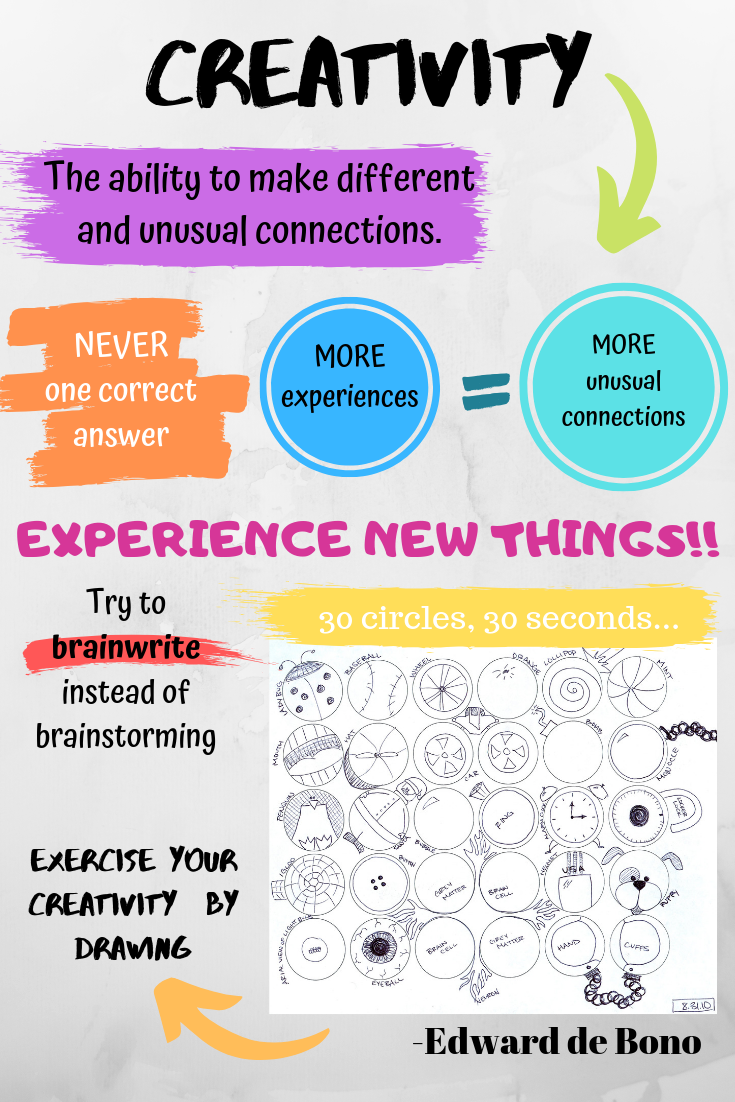
Never forget to enjoy the process!

…sharing your experience

“Testimony is responsible, either directly or indirectly, for much of what we know, not only about the world around us but also about who we are.“

J. Lackey, 2010

Even if we don’t realize, sharing experiences is one of our main sources of information; and it has been that way ever since we started communicating.

Nowadays testimonials are commonly used as benchmarks by new costumers and as a guarantee for quality and credibility, specially online.

Although testimonials may vary from simple sentences to talks, even to books; knowledge that is distinctively testimonial requires belief that is based or grounded in, not merely caused by, an instance of testimony. This means that the speaker has to believe his own testimonial for the hearer to believe it as well.

There are several attributes that make an effective testimonial, the most importan being the amount of information provided.  As the main purpose of a testimonial is to transmit information that will probably help make a decision, the hearer will most certainly be looking for proof of wether the testimonial is real or not and for as much information as he needs in order to make a good decision.

For example, lets say a costumer wants to leave a testimonial about his experience with an Airbnb host, he may write it as:

  • Great service, would recommend it.
  • The host was very helpful and always attentive to any doubts we had. He suggested a variety of things to do around the area.

Clearly the second option is better for new costumers and the host, as it provides more information and gives a better sense of confidence.

Lackey, J. 2010. Routledge companion to epistemology. http://faculty.wcas.northwestern.edu/~jal788/documents/TestimonialKnowledge.pdf

Design a site like this with WordPress.com
Get started