…Moonshot Thinking

We’ve talked about Disruptive Innovation and where it comes from. We said that for an innovation to be considered ‘disruptive’, it needs to present a new reality and create new habits by generating a new vision of the world. But we haven’t really seen the way to get there.

MOONSHOT THINKING is the answer

Here are 10 D’s that help to do Moonshot Thinking:

  • Digitalize: take any technology and make it digital.
  • Deceptive: growth in a fairly competition free zone.
  • Disruptive: change habits, people adapt to it.
  • Dematerialize: transformation from something you can hold to something that can spread.
  • Desmonetize: change business model, think freemium.
  • Democratize: available to the whole globe.
  • Disown: let the ownership to the users, exponential growth.
  • Depoliticise: transform the decision making process.
  • Dethrone & Deploy: transforms the labour market.
  • DIY: do it yourself.

Find something incredible to accomplish, set the timeframe and inspire toward action; just like John F. Kennedy did in 1962 when he said “We choose to go to the moon in this decade”, and planted the seeds that lead an entire country to go to the moon.

Resultado de imagen para moonshot thinking

…being curious

In the last blog we talked about DISRUPTIVE INNOVATION and what it is. But we didn’t talk about where it comes from.

As mentioned in the last blog DISRUPTIVE INNOVATION presents new realities and creates new habits. It starts with a new vision of the world.

How does that happen?

To change a reality we’d first have to understand the actual reality. To create a new vision of the world we need to comprehend the present one. To cause new habits it is crucial to know the existing ones. And to achieve this we turn to basic science.

BASIC SCIENCE looks for “knowledge and discovery of facts” that lead to a better understanding of natural phenomena. It comes from CURIOSITY and EXPLORATION.

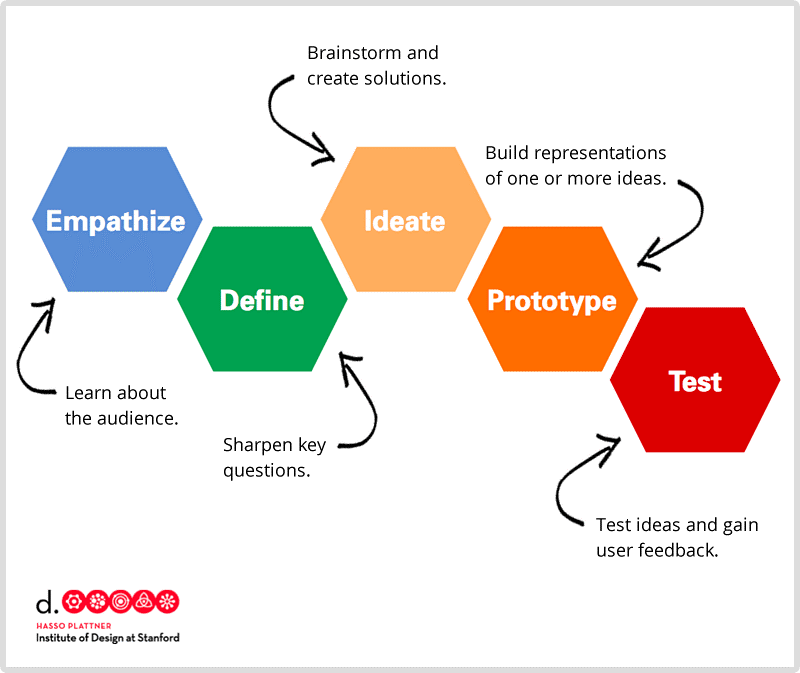
Similar to the EMPATHISING stage in Design Thinking, BASIC SCIENCE helps us understand the market. However, this time we don’t have a market yet and that is why research is needed to CREATE A NEW MARKET and do DISRUPTIVE INNOVATION afterwards.

The main purpose of BASIC SCIENCE is to discover new things, provide information and give insights. This insights are the key to Disruptive Innovation because they show a new need that hadn’t been seen. They create opportunities where no one expected them to be.

Solve all your question, you may find an opportunity in your answer.

STAY CURIOUS!

…disrupting

We all think we know what ‘Disruptive Innovation’ is, but do we actually do?

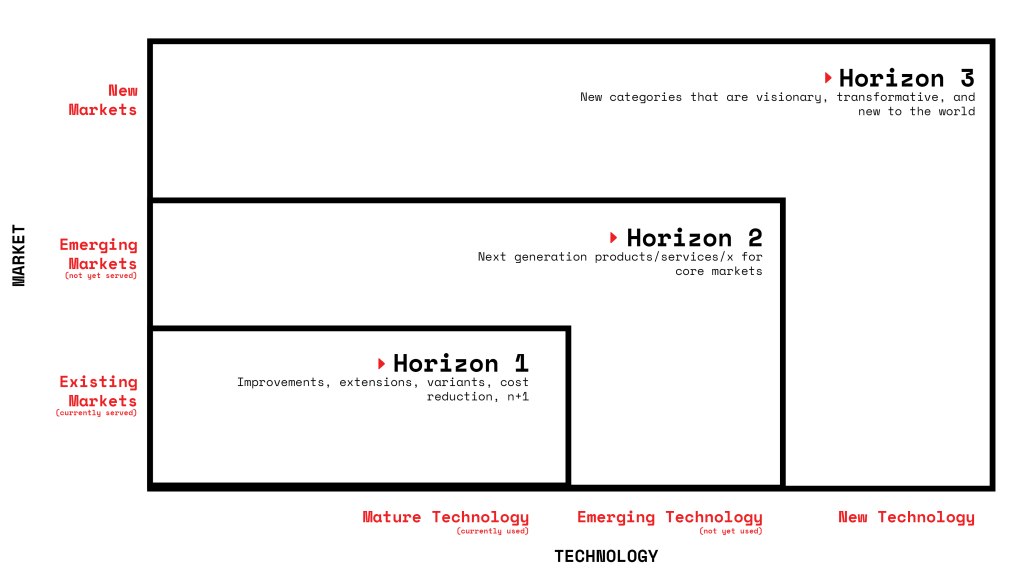
It is very common that we confuse Disruptive and Breakthrough innovations. To prevent this from happening we’ll clarify their meanings and differences. In order to do that, we first have to define the 3 horizons within the Market-Technology Matrix:

For a stablished brand, Horizon 3 normally gives 5% of their total income; it includes the new visionary categories for core markets and is where the exploration into new markets happens. Horizon 2 usually produces 25% of total income and is known as the ‘cold market’, the place for adjacent growth. Finally, Horizon 1 provides 70% of the total income and is composed of existing markets that need to be sustained.

As we can see, Horizon 1 is pretty important, therefore, we need to keep its customers happy with Sustaining Innovation, but that is not enough because they could get bored or other brands may gain them with newer technologies. That is why Horizons 2 and 3 are also very important. But what type of innovations are needed to satisfy these customers?

Horizon 2 is reached with Breakthrough Innovation because there is already an EXISTING MARKET looking for new alternatives to do what they already do in a different way.

On the other hand, Horizon 3 contains NON EXISTING MARKETS, and that is where Disruptive Innovation comes in place by presenting new realities and creating new habits. It starts with a new vision of the world.

It is as simple as that.

…forcing relations

Imagen relacionada

Sometimes we get stuck with the same idea, not knowing what to change or how to improve it.

Forced Relations is a methodology that makes us imagine the unimaginable.

The first step is to choose an animal or an object. This will be your new customer, therefore, you’ll have to get to know him, understand him, empathise with him.

Once you create your new PERSONA and identify his needs you can relate your product/service with him. Make the required changes and discover new possibilities.

Like the SCAMPER method, Forced Relations help us see our product/service from different perspectives and as a result we get new insights that help us identify the features that add the most value and maybe new possible solutions.

The image above can be a perfect example.

Our product is a pair of glasses and our new customer is a playful little dog. We’ll call him Spike.

Spike loves running and playing with his owners, but while he does, sometimes he crashes with things he cannot see without glasses. He is a little messy when he eats and he is very joyful.

By analysing Spike’s characteristics we’d have to design an smaller pair of glasses, maybe with an elastic at the back so they don’t come off when he is running and playing. The glasses might probably need to be water and dirt proof in order to stay clean. And they should be colourful to match with Spike’s joyful personality.

Once you look at the new product closely you may notice some features that could actually work for human’s needs. In this example the colourfulness and the elastic in the glasses match perfectly with a baby’s needs.

Imagine the craziest products with Forced Relations and find what you were looking for.

…SCAMPERing

What does it mean?

S – Substitute. Take a part of your concept and replace it with another one, you can find the perfect match.

C – Combine. The answer might already be out there. One idea could not work by itself, but when making the right combination a more efficient solution will result.

A – Adapt. Try changing your market and making the necessary changes, perhaps you find more customers.

M – Modify. Magnify and exaggerate the features of your solution, this will provide new insights, helping you identify what gives the most valuable attribute.

P – Put to another use. You probably have the right solution, just maybe not the right approach.

E – Eliminate. Get rid of any inefficient process, they are what create pains and someone else will possibly find the solution, making you lose your customers.

R – Reverse. Turn things around, redirect the purpose of your product/service. This will help looking at it from a different perspective.

Apply this method to make more creative and unusual connections. You may find answers where you least expected to.

Imagen relacionada

…observing

Earlier in the blog we talked about the Innovation Adaption Curve, where we can place our different types of clients; and also about Design Thinking, an iterative methodology for innovators. Today we’ll bring these topics together with:

Customer’s Journey

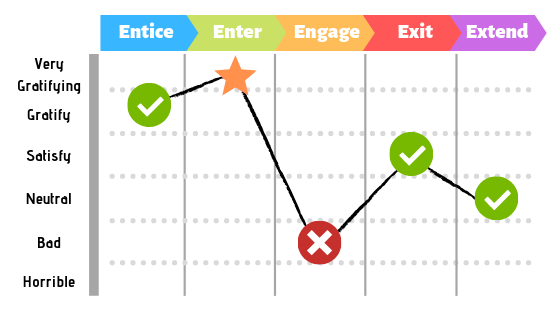
This is a tool very commonly used to analyze the whole experience the user has while interacting with our product/service. The template to apply the method is the following:

At the top we have the 5 E’s, which are the stages in the customer’s journey.

  1. Entice – How people first learn about our product/service. What draws them in? This is where we trigger the user to get into the UX funnel.
  2. Enter – The way in which people get involved; their first steps with the product/service.
  3. Engage – What is the user trying to do? What is he/she doing during his/her journey?
  4. Exit – How does the experience end?
  5. Extend – How do people keep in touch with the product/service? What happens when the job is done? What do clients takes with them, both physically and mentally?

Then, we have a table for the customer to rate each stage of the experience from horrible to very gratifying. This can help us identify what are the pains, and therefore we may use Design Thinking to improve their experience.

There are also STAR moments during the journey, and we should try to have as much of them as posible. The name stands for the characteristics that we look for in each stage: Simple, Transferable, Audience entered, Repeatable and Meaningful. What these moments do is that they give value, they offer competitive advantage and they make the customer remember us.

As you can see, first we have to understand our PERSONA, empathize with him/her, and identify his/her Job To Be Done. Once we get the real problem we create a solution, we prototype it and we test it with different types of clients (innovators, early adaptors, pragmatists, late majority, etc). Finally, we analyse their journey in order to identify new pains and iterate as many times as needed to get to the PERFECT PRODUCT/SERVICE.

What is the PERFECT PRODUCT/SERVICE?

The one that doesn’t need anything to be added or taken away.

…knowing your PERSONA

Now that we know how to create our PERSONA, we can talk about its usefulness.

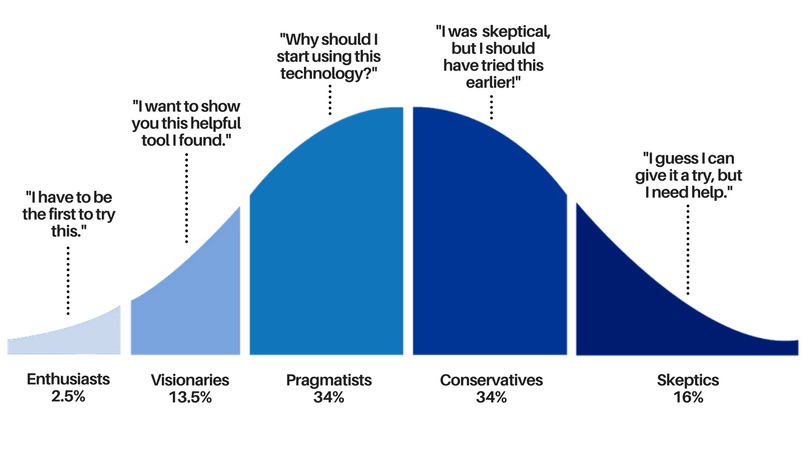
The Job To Be Done of our PERSONA tells us the reason WHY he/she wants a product or service. This reason can vary between actual customers and it can change with time. This behaviour can be represented by the following graph:

INNOVATION ADAPTION CURVE

At the beginning most of our users will be innovators and enthusiasts, because they’ll buy our offer trusting blindly in it’s success.

Later on we’ll find the visionaries, the early adaptors who’ve heard form innovators about our product/service and are trying to get the hang of it.

After them, we have the early majority and pragmatists who are currently starting to use our product/service and introducing us to new customers.

When this new customers add up, they’ll all become the late majority, the conservatives that are now familiar with our product/service and wish they’d found it earlier.

Finally, we have the skeptics, the people that would never buy our product/service on their own because they’re no fully convinced by it.

All of these types of customers help us improve our solution, specially the EXTREME USERS: Innovators and Skeptics. They can tell us a lot about what we’re doing right and wrong, and we should take this in our advantage.

Information is the most valuable asset.

…defining your PERSONA

Persona… yeah, it means ‘person’ in Spanish, but why is it important?

For innovators it doesn’t just mean ‘person’, it means: PERFECT CUSTOMER.

In the last post we talked about empathy and the importance of understanding the user before creating any solution. Today we’ll take a closer look at the stage of getting to know our clients through the definition of a PERSONA.

Every single one of us has a personality, but we all have things in common too. The goal of defining a PERSONA is to identify a common pain or need in order to find the perfect solution.

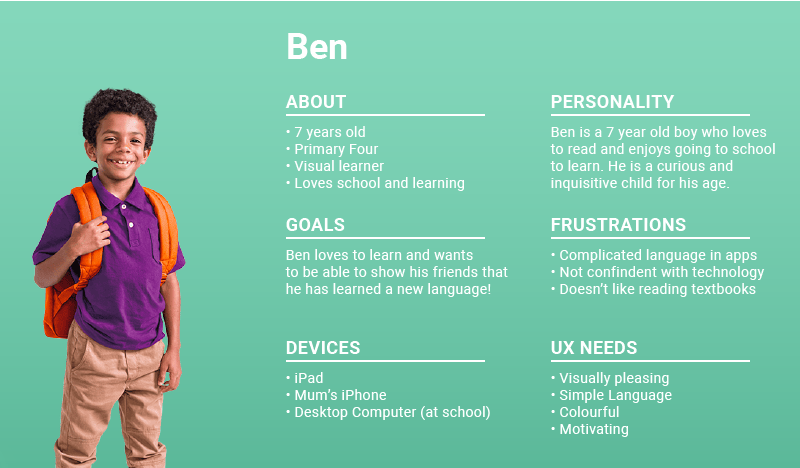
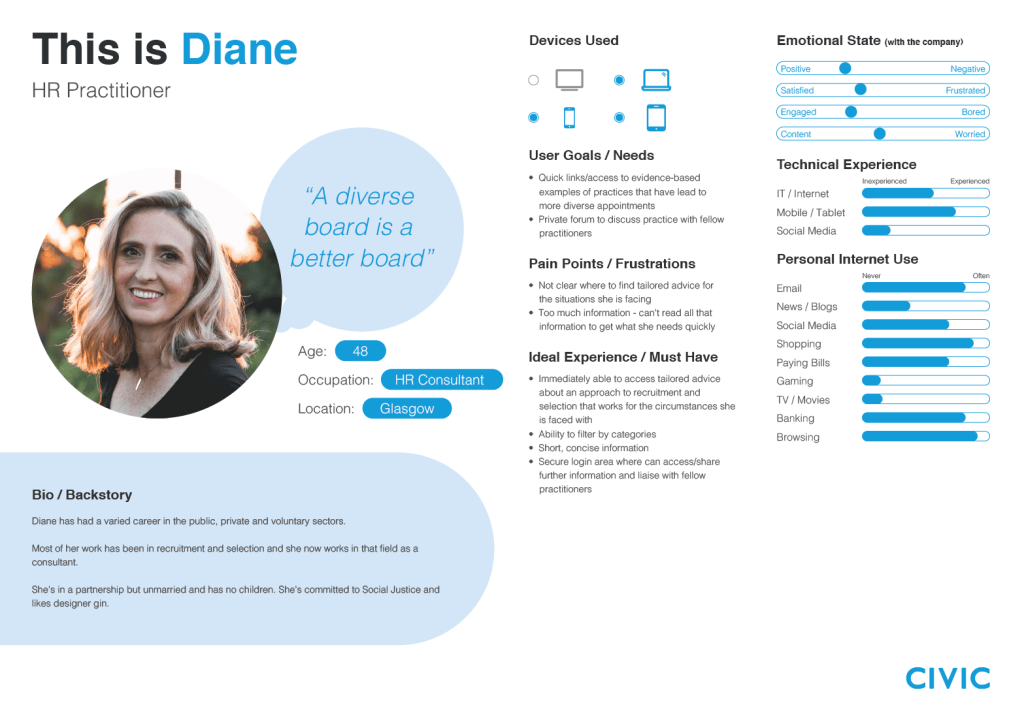
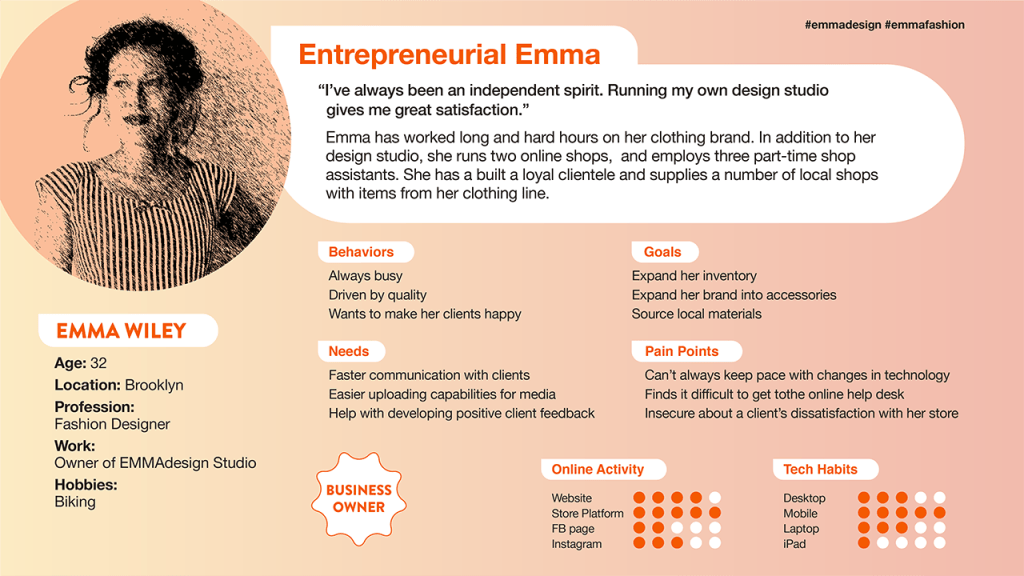
We can use several templates to find the PERSONA that represents our ideal customer, here are some examples:

The most important features to add are: personality, values, attitudes, interests and lifestyle. These will help us determine the real problem.

There are many reasons why we pay for something, but to summarise them all we can say that every time we buy something it is because it gets a job done. This product or service help us get from point A to point B, solving any problems in the way and making it easier to achieve the goal.

After defining our PERSONA, we have to identify this “Job To Be Done” ; we need to find the reason WHY he/she would pay for a product or service.

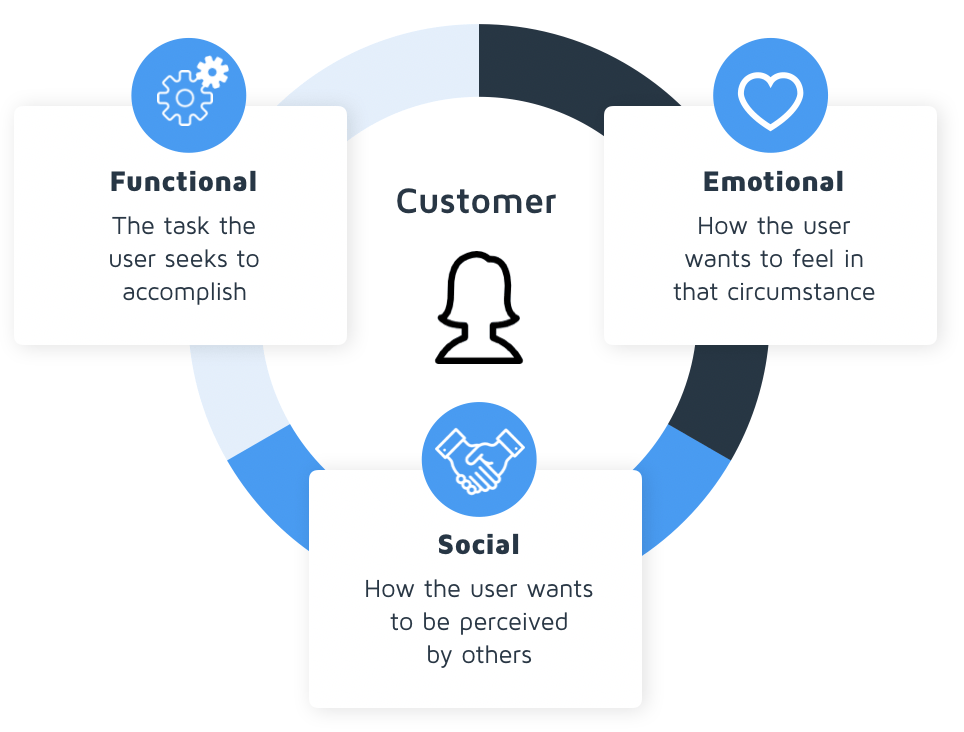
Within this “Job To Be Done” there are three categories in which every product and service will fit:

The key question (job statement) to discover the customer’s need is:

Is there a better way for ………………. (persona)

to do ……………………. (progress activity)

in ………………… (place/situation).

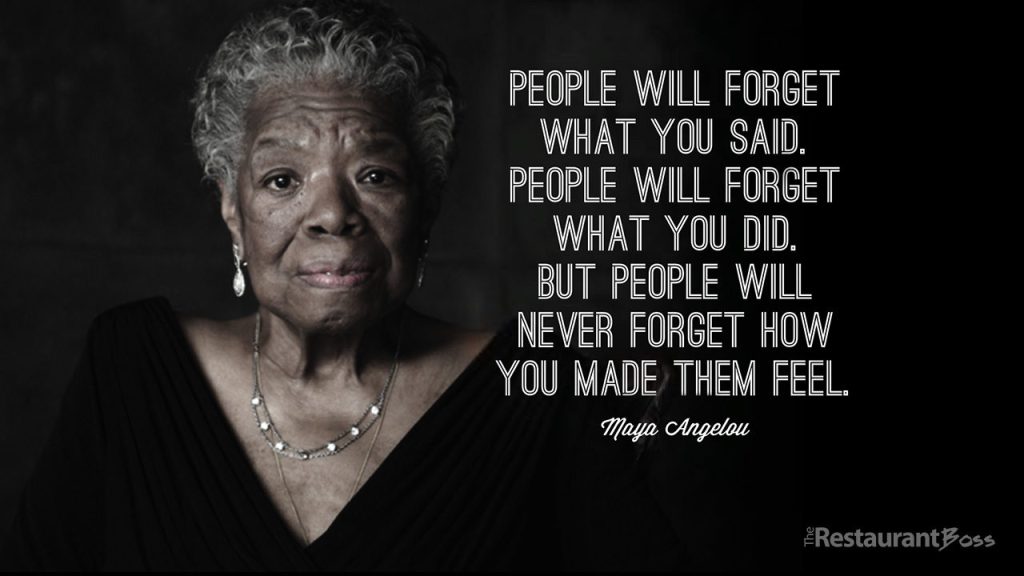
Go define your PERSONA, identify the Job To Be Done, create something that gets that job done, and always keep in mind:

… empathising

THE KEY OF DESIGN THINKING

We all have problems that need to be solved, and Design Thinking is the perfect tool to find the perfect solutions.

What is Design Thinking?

It is an customer centered innovation method, created by Stanford University and IDEO, that helps to understand the customer through EMPATHY.  After empathising you need to identify a problem, ideate, build and test solutions.

The main purpose of the process is to create a product that is very intuitive, simple and self explanatory.

To achieve this, we must arrange elements that make sense. And… how do we get there? We let the customer design the perfect solution. We just have to make the right questions and always LISTEN carefully to his/her answers.

With each idea, try to create a prototype that makes the user engage in a testable experience so you can get information out of his/her reactions and interactions. Talk as little as possible, let him/her give you all the answers you need and take every reaction in your advantage, he/she might help you see something you were missing.

Be patient, this is an iterative process, with each feedback you’ll get new ideas and with them new feedback, repeating the cycle all over again.

Keep in mind that we’re looking for solutions to a specific problem, not customers for a special product. Therefore, we must never defend our ideas, instead, we should always look for improvement. In this way, and only this one, we can get to the MVP (Minimum Viable product), which is always the goal.

You can get there!

…keeping your feet on the ground

The consequences of not being realistic can be catastrophic and a perfect example of this is Elizabeth Holme’s case.

She started Theranos, a company based on an idea that could not be done, or at least not the way she wanted it to. People tried to talk her out of it, but she didn’t hear and kept on going until she lost her sense of reality, affecting too many people in the process.

Elizabeth at Theranos

We have to recognize that Elizabeth was very persistent, smart and great at networking. She knew how to use her abilities for her advantage, but she reached the limits. She was so persistent that she ignored and even fired anyone who disagreed with her. She was so smart that she knew exactly what to say to fool everyone. And she was so good at networking that she made true followers out of very important people.

Although she made these mistakes, they all came from the same foundation: she fell in love with her solution instead of the problem.

We should NEVER innovate for money or any reason other than solving a problem, that is what makes an innovation great and what really adds value to it. We always need to have this in mind, if not… well, we might be at risk of losing our sense of reality too.

Design a site like this with WordPress.com
Get started