Earlier in the blog we talked about the Innovation Adaption Curve, where we can place our different types of clients; and also about Design Thinking, an iterative methodology for innovators. Today we’ll bring these topics together with:
Customer’s Journey
This is a tool very commonly used to analyze the whole experience the user has while interacting with our product/service. The template to apply the method is the following:
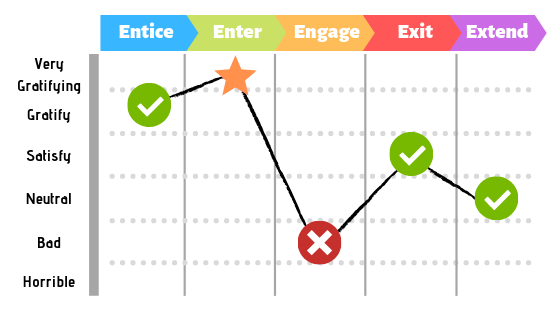
At the top we have the 5 E’s, which are the stages in the customer’s journey.
- Entice – How people first learn about our product/service. What draws them in? This is where we trigger the user to get into the UX funnel.
- Enter – The way in which people get involved; their first steps with the product/service.
- Engage – What is the user trying to do? What is he/she doing during his/her journey?
- Exit – How does the experience end?
- Extend – How do people keep in touch with the product/service? What happens when the job is done? What do clients takes with them, both physically and mentally?
Then, we have a table for the customer to rate each stage of the experience from horrible to very gratifying. This can help us identify what are the pains, and therefore we may use Design Thinking to improve their experience.
There are also STAR moments during the journey, and we should try to have as much of them as posible. The name stands for the characteristics that we look for in each stage: Simple, Transferable, Audience entered, Repeatable and Meaningful. What these moments do is that they give value, they offer competitive advantage and they make the customer remember us.
As you can see, first we have to understand our PERSONA, empathize with him/her, and identify his/her Job To Be Done. Once we get the real problem we create a solution, we prototype it and we test it with different types of clients (innovators, early adaptors, pragmatists, late majority, etc). Finally, we analyse their journey in order to identify new pains and iterate as many times as needed to get to the PERFECT PRODUCT/SERVICE.
What is the PERFECT PRODUCT/SERVICE?
The one that doesn’t need anything to be added or taken away.

